
Dysphagia in care homes is an important consideration for staff responsible for supporting residents with eating, drinking, nutrition and hydration. When swallowing difficulties are not recognised or managed appropriately, residents may face increased risks of choking, aspiration, dehydration, malnutrition and respiratory complications.
For care home managers, nurses, care assistants and catering teams, understanding dysphagia is an essential part of delivering safe, person-centred care.
However, mistakes can occur even in settings where staff are experienced and committed to providing high-quality support. Problems may arise through poor communication, incorrect food preparation, inconsistent care plans or misunderstandings about the International Dysphagia Diet Standardisation Initiative (IDDSI) Framework.
This guide explores 10 common dysphagia mistakes in care homes, explains why they matter and identifies practical steps that organisations can take to reduce avoidable risks.
What Is Dysphagia?
Dysphagia is the medical term for difficulty swallowing. It can affect a person’s ability to swallow food, drinks, saliva or medication safely and effectively.
Swallowing difficulties may occur alongside conditions such as:
- Stroke and other neurological conditions.
- Parkinson’s disease.
- Dementia.
- Motor neurone disease.
- Head and neck conditions or surgery.
- Frailty and certain age-related changes.
Not everyone with these conditions will experience dysphagia, and swallowing difficulties can also develop for other reasons.
Some residents may cough or choke during meals, while others may experience less obvious symptoms. Importantly, aspiration can sometimes occur without coughing, a phenomenon known as silent aspiration.
Dysphagia therefore requires individual assessment, appropriate professional input and consistent implementation of recommended care.
1. Failing to Recognise the Warning Signs of Dysphagia
One of the most significant mistakes is assuming that swallowing difficulties will always be obvious.
Recognising the early signs of dysphagia in care homes is essential for identifying residents who may need further assessment and support.
Residents may develop changes gradually, and early warning signs can be overlooked during busy mealtimes.
Possible indicators include:
- Coughing or choking when eating or drinking.
- A wet or gurgly-sounding voice after swallowing.
- Food remaining in the mouth after meals.
- Difficulty chewing or controlling food.
- Repeated throat clearing.
- Taking unusually long to finish meals.
- Unexplained weight loss or reduced food intake.
- Recurrent chest infections.
These symptoms do not automatically confirm dysphagia, but they should prompt appropriate assessment.
How care homes can reduce the risk
Staff should understand the signs that require attention and know how to report concerns promptly.
New or worsening swallowing difficulties should be escalated according to the resident’s care plan and local procedures, with referral to an appropriate healthcare professional, often a Speech and Language Therapist (SLT).
Key point: Staff should never assume that the absence of coughing means swallowing is safe.
2. Providing the Wrong IDDSI Food Texture
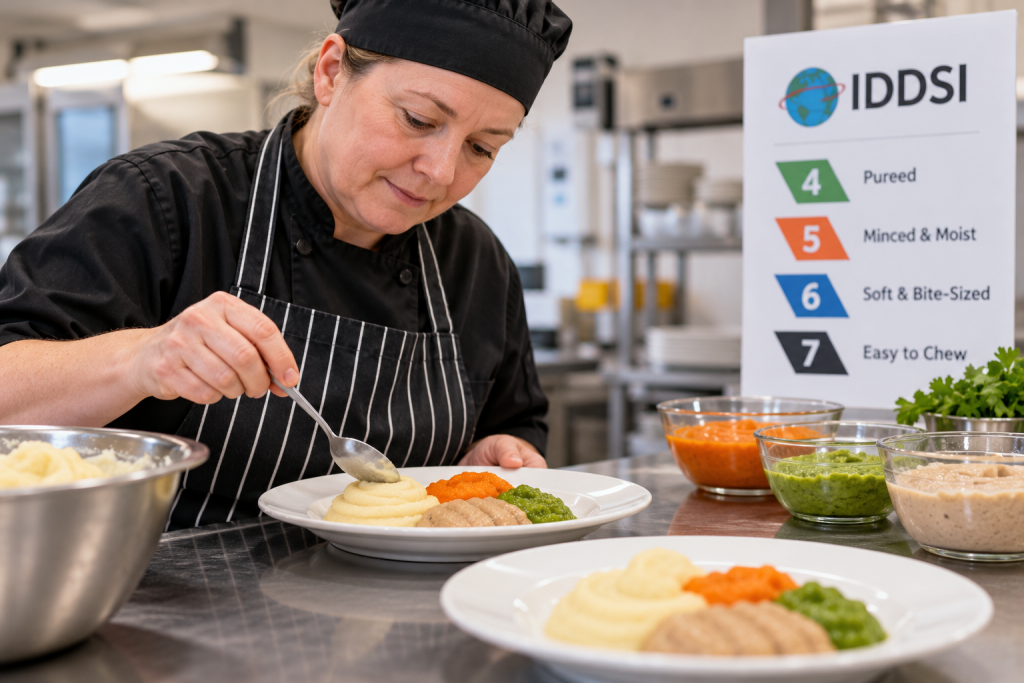
The IDDSI Framework provides standardised terminology and testing methods for food textures and drink thicknesses.
It helps healthcare professionals, care staff and catering teams communicate more consistently about texture-modified diets.
For foods, commonly used IDDSI levels include:
- Level 3 – Liquidised
- Level 4 – Pureed
- Level 5 – Minced & Moist
- Level 6 – Soft & Bite-Sized
- Level 7 – Regular or Easy to Chew, depending on the designation
Each level has specific characteristics and, where applicable, testing requirements.
A common mistake is assuming that food is suitable simply because it looks soft or has been chopped into smaller pieces.
For example, IDDSI Level 5 Minced & Moist food must meet defined particle-size and moisture requirements. For adults, food particles should generally be no larger than 4 mm in width.
IDDSI Level 6 Soft & Bite-Sized food has different requirements, including adult bite-sized pieces generally no larger than 1.5 cm in their longest dimension, alongside appropriate softness and texture.
How care homes can reduce the risk
Catering teams should prepare food according to the resident’s documented recommendations and the relevant IDDSI testing methods.
Visual appearance alone is not sufficient to establish that a meal meets an IDDSI level.
Staff must not independently change a resident’s prescribed food texture because another consistency appears easier to prepare or serve.
Key point: Correct IDDSI classification depends on the food’s properties and testing, not simply its appearance.
3. Preparing Thickened Drinks Incorrectly
Some residents with dysphagia may be advised to use thickened drinks following an individual swallowing assessment.
Managing dysphagia in care homes also requires staff to understand the importance of preparing drinks according to individual clinical recommendations.
The IDDSI Framework identifies drink thickness levels from Level 0 (Thin) through to Level 4 (Extremely Thick).
A frequent mistake is preparing drinks by estimation rather than following the recommended product instructions and required consistency.
Problems may arise when:
- Incorrect quantities of thickener are used.
- Mixing instructions are not followed.
- Staff assume all thickening products behave identically.
- Drinks are served before the required consistency has developed.
- The consistency changes during standing or serving.
Thickened drinks are not suitable for every person with dysphagia. Their use requires individual clinical consideration, including potential effects on hydration, comfort and quality of life.
How care homes can reduce the risk
Where thickened drinks have been recommended, staff should follow the resident’s swallowing-management plan, the specific thickener’s instructions and relevant IDDSI testing guidance.
Any concerns about acceptance, hydration or swallowing safety should be reported to the appropriate healthcare professional.
Key point: Staff must never introduce, discontinue or alter thickened drinks without appropriate clinical guidance.
4. Poor Communication Between Care and Catering Teams
Effective dysphagia management depends on accurate communication.
A resident’s swallowing recommendations may be documented correctly in their care plan, but mistakes can occur if the kitchen team does not receive updated information.
For example, a resident may have a revised texture recommendation following an SLT assessment. If the change is not communicated to the catering team, an unsuitable meal could be prepared.
Other communication failures include:
- Outdated dietary lists.
- Unclear food texture instructions.
- Incomplete handovers.
- Temporary staff not receiving essential information.
- Changes being communicated verbally but not documented.
How care homes can reduce the risk
Care homes should establish reliable procedures for sharing and confirming dietary requirements.
These may include updated kitchen records, clear meal identification, documented handovers and checks before meals are served.
Confidential resident information should be shared only with staff who need it to deliver care safely.
Key point: A swallowing recommendation is only effective when everyone responsible for implementing it has accurate information.
5. Not Following Individual Swallowing Care Plans
Two residents with dysphagia may have very different needs.
Effective management of dysphagia in care homes depends on following each resident’s individual swallowing care plan.
One person may require a modified food texture, while another may need specific positioning, supervision or swallowing strategies recommended by an SLT.
A common mistake is applying a general approach to everyone with dysphagia.
For example, staff may assume that all residents with swallowing difficulties should receive pureed meals or thickened drinks.
This can result in inappropriate restrictions, reduced food enjoyment or potentially unsafe care.
How care homes can reduce the risk
Staff should follow each resident’s individual, current swallowing-management plan.
Where relevant, this may include:
- Recommended food and drink consistencies.
- Appropriate seating and positioning.
- Required supervision or assistance.
- Specific strategies advised by the SLT.
- Procedures for reporting changes or difficulties.
- Agreed actions if the resident declines recommended modifications.
Care should also respect the resident’s preferences, dignity and rights, including appropriate involvement in decisions.
Key point: Dysphagia management must be individualised rather than based on assumptions about a diagnosis.
6. Inadequate Positioning and Mealtime Support
The way a resident is positioned and supported during meals can affect their ability to eat and drink comfortably and safely.
Potential problems include residents being served meals while poorly supported, rushing assistance or failing to follow specific positioning recommendations.
Staff may also overlook fatigue, reduced alertness or changes in the person’s ability to manage a meal.
How care homes can reduce the risk
Care teams should follow the individual’s assessed positioning and mealtime-support recommendations.
Where appropriate, this may involve helping the resident achieve a stable, supported upright position, providing suitable assistance and allowing sufficient time to eat.
Staff should also recognise when a resident appears unusually drowsy, distressed or unable to manage food or fluids as expected.
Any deterioration should be escalated promptly.
Key point: Safe mealtime support involves more than serving the correct food texture.
7. Assuming Texture-Modified Meals Are Automatically Safe
Preparing food to the correct IDDSI level is important, but it does not guarantee that swallowing will be safe for every resident.
Other factors can affect swallowing, including fatigue, illness, medication effects, positioning, oral health and changes in neurological function.
A resident who previously managed a particular texture may develop new difficulties.
There is also a risk of overlooking mixed-consistency foods, such as cereal with milk or soup containing solid pieces, which may not meet a resident’s recommended texture requirements.
How care homes can reduce the risk
Staff should remain attentive to changes in residents’ eating and drinking abilities and follow their individual care plans.
Catering teams should understand how ingredients, sauces and food combinations affect the final texture of a meal.
Where there is uncertainty about whether a dish meets the required IDDSI level, it should be checked rather than served on assumption.
Key point: IDDSI supports consistency in food and drink preparation, but individual clinical assessment remains essential.
8. Overlooking Hydration and Nutritional Needs
Residents with dysphagia may be at increased risk of inadequate food and fluid intake.
Supporting residents with dysphagia in care homes involves monitoring nutritional intake and hydration alongside swallowing safety.
Texture modifications, swallowing difficulties, fatigue, reduced appetite and dislike of modified meals can all contribute.
A common mistake is concentrating exclusively on the prescribed texture while overlooking whether the resident is consuming enough food and fluid.
Possible warning signs include:
- Reduced meal consumption.
- Declining fluid intake.
- Unintentional weight loss.
- Increased tiredness or weakness.
- Repeated refusal of modified meals or drinks.
How care homes can reduce the risk
Care homes should monitor nutritional and hydration risks in accordance with individual assessments and organisational procedures.
Where concerns arise, staff should seek input from relevant professionals, such as dietitians, SLTs, nurses or medical practitioners.
Texture-modified meals should remain appetising, appropriately presented and nutritionally suitable.
Key point: Dysphagia care must balance swallowing safety with adequate nutrition, hydration and quality of life.
9. Failing to Train Temporary and Newly Recruited Staff
Care homes frequently rely on a combination of permanent employees, agency workers and temporary catering staff.
A common risk is assuming that all workers already understand dysphagia terminology and IDDSI requirements.
Staff may have experience in care or food preparation without having received specific dysphagia awareness training.
This can create inconsistencies in meal preparation, serving and reporting.
How care homes can reduce the risk
Organisations should provide role-appropriate induction and training.
Care assistants may need to understand warning signs, individual swallowing plans, mealtime assistance and escalation procedures.
Catering staff may require additional practical competence in texture-modified food preparation and IDDSI testing methods.
Managers should also ensure that temporary workers receive essential resident-specific instructions before undertaking relevant duties.
Awareness training supports knowledge but does not replace supervised practical competency assessment or professional clinical instruction where these are required.
Key point: Staff competence should be appropriate to their responsibilities, not assumed from their job title.
10. Failing to Review and Update Dysphagia Care Arrangements
Swallowing needs can change over time.
Regular reviews of dysphagia in care homes help ensure that swallowing recommendations remain appropriate as residents’ needs change.
A resident may experience deterioration following an illness or neurological event, or their swallowing ability may improve following treatment and rehabilitation.
One common mistake is allowing old swallowing recommendations to remain in use without appropriate review when circumstances change.
This can lead to unnecessary dietary restrictions or continued use of arrangements that no longer meet the resident’s needs.
How care homes can reduce the risk
Care plans should be reviewed in accordance with clinical recommendations, organisational procedures and any changes in the resident’s condition.
Staff should report concerns promptly and seek reassessment when indicated.
Changes to food texture, drink thickness or swallowing strategies should be made through the appropriate clinical decision-making process.
Key point: A swallowing-management plan should remain current and responsive to the resident’s changing needs.
Why the IDDSI Framework Matters in Care Homes
The International Dysphagia Diet Standardisation Initiative was developed to provide common terminology and practical methods for describing texture-modified foods and thickened drinks.
For care homes, this supports clearer communication between clinical professionals, care teams and catering staff.
However, implementing IDDSI effectively involves more than displaying a chart in the kitchen.
Organisations need to ensure that relevant staff understand the framework, can apply appropriate testing methods within their roles and know when to seek professional advice.
It is also important to recognise that IDDSI describes food and drink characteristics; it does not determine which level is clinically appropriate for an individual.
That decision must be informed by the person’s swallowing assessment and care needs.
Practical Dysphagia Safety Checklist for Care Home Managers
Managers can use the following questions when reviewing dysphagia-related arrangements:
- Are residents with swallowing difficulties appropriately assessed?
- Are individual swallowing recommendations documented and accessible to relevant staff?
- Do care and catering teams receive updates promptly?
- Are IDDSI food and drink requirements understood by the staff preparing and serving them?
- Are meals checked against the appropriate texture requirements?
- Do temporary and newly recruited staff receive suitable instructions?
- Are changes in swallowing ability reported and escalated?
- Are nutritional intake, hydration and resident preferences considered?
- Are relevant staff trained and assessed as competent for their duties?
- Are swallowing care plans reviewed when residents’ needs change?
These questions can support internal quality improvement, but they are not a substitute for professional assessment, organisational risk management or regulatory requirements.
Supporting Staff Knowledge Through Dysphagia Awareness Training
Effective dysphagia care depends on staff recognising risks, understanding their responsibilities and working consistently with individual care plans.
For organisations employing care assistants, healthcare support workers, catering staff and care home managers, structured awareness training can help develop a shared understanding of dysphagia and the IDDSI Framework.
FlexiLearnHub provides online training designed to introduce important principles of dysphagia awareness, food and drink textures, risk recognition and professional responsibilities.
Explore Our Dysphagia Awareness & IDDSI Framework Training
Our Dysphagia Awareness & IDDSI Framework Training (CPD Accredited) course supports care and catering professionals who want to strengthen their awareness of swallowing difficulties and the internationally recognised IDDSI Framework.
View Dysphagia Awareness & IDDSI Framework Training
The course is an awareness-level learning resource. It does not qualify learners to diagnose dysphagia, prescribe food or drink consistencies, or independently modify an individual’s swallowing-management plan.
Conclusion: Reducing Dysphagia Risks Through Consistent Practice
Dysphagia in care homes requires careful attention, effective teamwork and a person-centred approach.
Mistakes involving incorrect food textures, poorly prepared drinks, outdated care plans or inadequate communication can have serious consequences.
By recognising warning signs, following individual clinical recommendations, using IDDSI terminology correctly and supporting staff competence, care homes can strengthen their approach to eating and drinking safety.
Above all, safe dysphagia care is not simply about changing food textures. It is about understanding each resident’s needs, protecting their dignity and ensuring that appropriate professional guidance is followed consistently.
Further Reading and Professional Guidance
- International Dysphagia Diet Standardisation Initiative (IDDSI) — official framework, food and drink testing methods and resources.
- Royal College of Speech and Language Therapists (RCSLT) — professional information about speech and language therapy and dysphagia.
- NHS — information about swallowing problems, symptoms and treatment.
Disclaimer: This article provides general educational information for care and catering professionals. It does not replace individual clinical assessment, Speech and Language Therapy advice, or a resident’s prescribed swallowing-management plan. Sudden inability to swallow, choking or breathing difficulties require immediate appropriate emergency action.