
Dysphagia in Care Homes: 10 Common Mistakes Staff Must Avoid
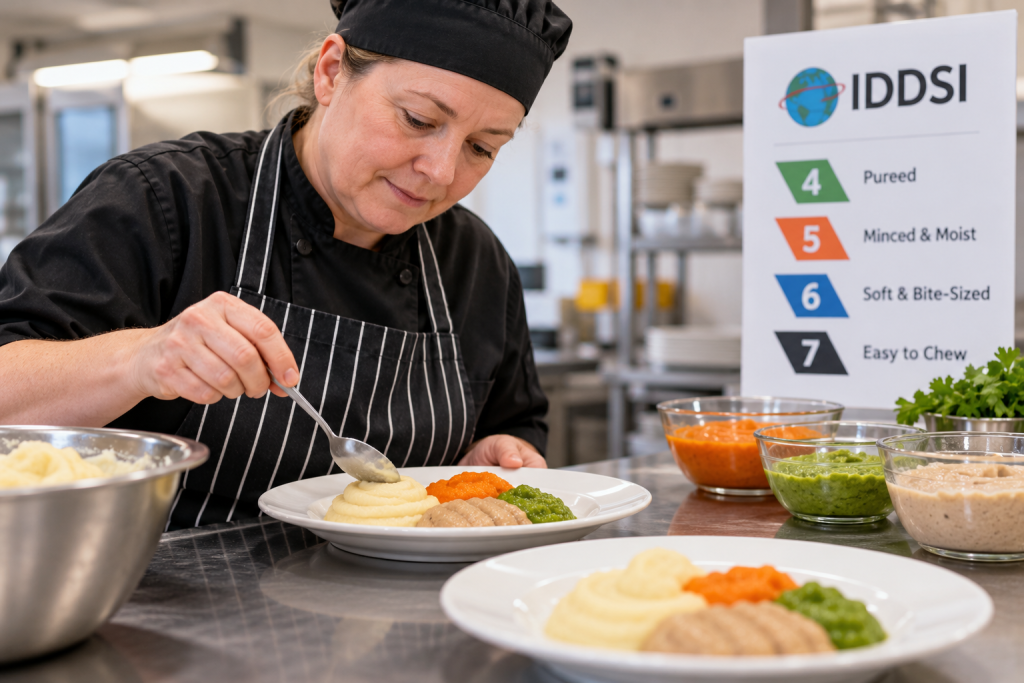
Dysphagia in care homes is an important consideration for staff responsible for supporting residents with eating, drinking, nutrition and hydration. When swallowing difficulties are not recognised or managed appropriately, residents may face increased risks of choking, aspiration, dehydration, malnutrition and respiratory complications. For care home managers, nurses, care assistants and catering teams, understanding dysphagia is an essential part of delivering safe, person-centred care. However, mistakes can occur even in settings where staff are experienced and committed to providing high-quality support. Problems may arise through poor communication, incorrect food preparation, inconsistent care plans or misunderstandings about the International Dysphagia Diet Standardisation Initiative (IDDSI) Framework. This guide explores 10 common dysphagia mistakes in care homes, explains why they matter and identifies practical steps that organisations can take to reduce avoidable risks. What Is Dysphagia? Dysphagia is the medical term for difficulty swallowing. It can affect a person’s ability to swallow food, drinks, saliva or medication safely and effectively. Swallowing difficulties may occur alongside conditions such as: Not everyone with these conditions will experience dysphagia, and swallowing difficulties can also develop for other reasons. Some residents may cough or choke during meals, while others may experience less obvious symptoms. Importantly, aspiration can sometimes occur without coughing, a phenomenon known as silent aspiration. Dysphagia therefore requires individual assessment, appropriate professional input and consistent implementation of recommended care. 1. Failing to Recognise the Warning Signs of Dysphagia One of the most significant mistakes is assuming that swallowing difficulties will always be obvious. Recognising the early signs of dysphagia in care homes is essential for identifying residents who may need further assessment and support. Residents may develop changes gradually, and early warning signs can be overlooked during busy mealtimes. Possible indicators include: These symptoms do not automatically confirm dysphagia, but they should prompt appropriate assessment. How care homes can reduce the risk Staff should understand the signs that require attention and know how to report concerns promptly. New or worsening swallowing difficulties should be escalated according to the resident’s care plan and local procedures, with referral to an appropriate healthcare professional, often a Speech and Language Therapist (SLT). Key point: Staff should never assume that the absence of coughing means swallowing is safe. 2. Providing the Wrong IDDSI Food Texture The IDDSI Framework provides standardised terminology and testing methods for food textures and drink thicknesses. It helps healthcare professionals, care staff and catering teams communicate more consistently about texture-modified diets. For foods, commonly used IDDSI levels include: Each level has specific characteristics and, where applicable, testing requirements. A common mistake is assuming that food is suitable simply because it looks soft or has been chopped into smaller pieces. For example, IDDSI Level 5 Minced & Moist food must meet defined particle-size and moisture requirements. For adults, food particles should generally be no larger than 4 mm in width. IDDSI Level 6 Soft & Bite-Sized food has different requirements, including adult bite-sized pieces generally no larger than 1.5 cm in their longest dimension, alongside appropriate softness and texture. How care homes can reduce the risk Catering teams should prepare food according to the resident’s documented recommendations and the relevant IDDSI testing methods. Visual appearance alone is not sufficient to establish that a meal meets an IDDSI level. Staff must not independently change a resident’s prescribed food texture because another consistency appears easier to prepare or serve. Key point: Correct IDDSI classification depends on the food’s properties and testing, not simply its appearance. 3. Preparing Thickened Drinks Incorrectly Some residents with dysphagia may be advised to use thickened drinks following an individual swallowing assessment. Managing dysphagia in care homes also requires staff to understand the importance of preparing drinks according to individual clinical recommendations. The IDDSI Framework identifies drink thickness levels from Level 0 (Thin) through to Level 4 (Extremely Thick). A frequent mistake is preparing drinks by estimation rather than following the recommended product instructions and required consistency. Problems may arise when: Thickened drinks are not suitable for every person with dysphagia. Their use requires individual clinical consideration, including potential effects on hydration, comfort and quality of life. How care homes can reduce the risk Where thickened drinks have been recommended, staff should follow the resident’s swallowing-management plan, the specific thickener’s instructions and relevant IDDSI testing guidance. Any concerns about acceptance, hydration or swallowing safety should be reported to the appropriate healthcare professional. Key point: Staff must never introduce, discontinue or alter thickened drinks without appropriate clinical guidance. 4. Poor Communication Between Care and Catering Teams Effective dysphagia management depends on accurate communication. A resident’s swallowing recommendations may be documented correctly in their care plan, but mistakes can occur if the kitchen team does not receive updated information. For example, a resident may have a revised texture recommendation following an SLT assessment. If the change is not communicated to the catering team, an unsuitable meal could be prepared. Other communication failures include: How care homes can reduce the risk Care homes should establish reliable procedures for sharing and confirming dietary requirements. These may include updated kitchen records, clear meal identification, documented handovers and checks before meals are served. Confidential resident information should be shared only with staff who need it to deliver care safely. Key point: A swallowing recommendation is only effective when everyone responsible for implementing it has accurate information. 5. Not Following Individual Swallowing Care Plans Two residents with dysphagia may have very different needs. Effective management of dysphagia in care homes depends on following each resident’s individual swallowing care plan. One person may require a modified food texture, while another may need specific positioning, supervision or swallowing strategies recommended by an SLT. A common mistake is applying a general approach to everyone with dysphagia. For example, staff may assume that all residents with swallowing difficulties should receive pureed meals or thickened drinks. This can result in inappropriate restrictions, reduced food enjoyment or potentially unsafe care. How care homes can reduce the risk Staff should follow each resident’s individual, current swallowing-management plan. Where relevant,
What Are Texture Modified Meals? A Guide for Care & Catering Teams
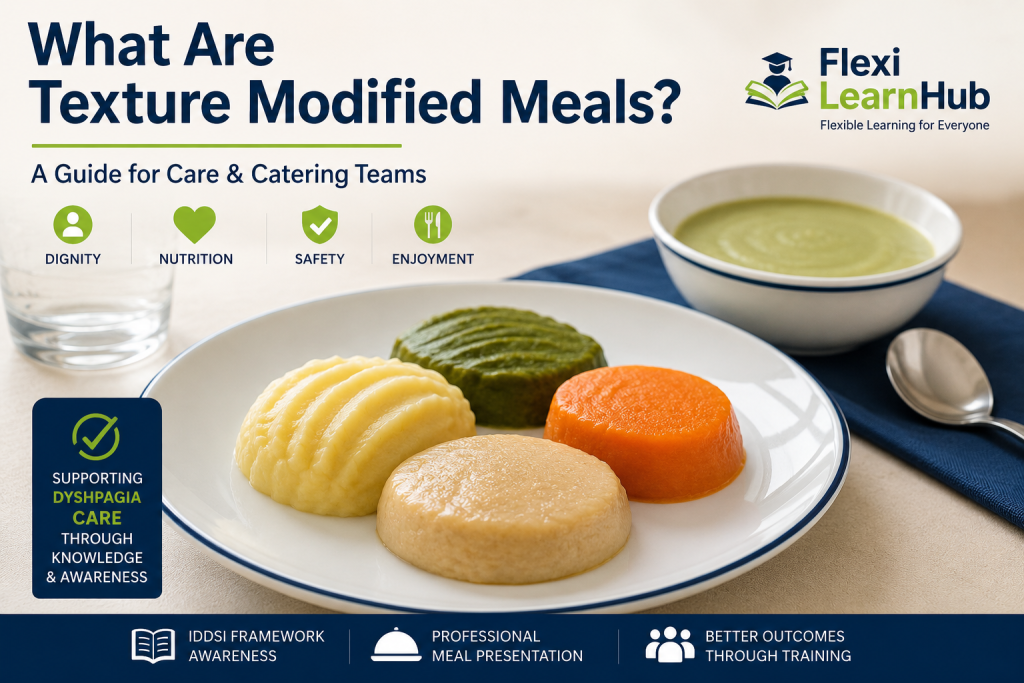
Within healthcare, care homes and specialist catering environments, texture modified meals play an important role in supporting individuals who may require modified food textures as part of their care and support arrangements. As awareness of dysphagia and specialist dietary requirements continues to grow, understanding texture modified meals is becoming increasingly important for care staff, catering teams and healthcare professionals. Understanding Texture Modified Meals Texture modified meals are foods that have been prepared, adapted or modified to achieve a specific texture or consistency. These meals are commonly used within healthcare, aged care and specialist care environments where individuals may require food textures that differ from standard meals. The goal is to provide meals that are suitable for an individual’s assessed needs while still supporting nutrition, hydration and positive mealtime experiences. Why Are Texture Modified Meals Important? Mealtimes are about far more than simply providing food. Within care environments, mealtimes can contribute to wellbeing, dignity, comfort and social interaction. Professional preparation and presentation of texture modified meals can help support: ✔ Positive mealtime experiences ✔ Dignity and respect ✔ Professional catering standards ✔ Visual appeal ✔ Consistency within care catering environments For catering teams, understanding texture modified meals is increasingly recognised as an important part of professional practice. The Role of the IDDSI Framework he International Dysphagia Diet Standardisation Initiative (IDDSI) Framework provides internationally recognised terminology and guidance relating to texture modified foods and drinks. The framework helps support consistency across healthcare, aged care and specialist catering environments. Many organisations now use the IDDSI Framework as part of their workplace awareness and professional development programmes. For a more detailed overview, visit our dedicated: IDDSI & Dysphagia Awareness Training Hub Why Professional Presentation Still Matters One common misconception is that texture modified meals cannot look appealing. In reality, professional meal presentation remains an important part of modern care catering. Thoughtfully presented meals can help support: ✔ Mealtime dignity ✔ Visual appeal ✔ Positive dining experiences ✔ Professional workplace standards ✔ Confidence within catering teams This is one reason why specialist awareness around professional purée presentation and plating is becoming increasingly popular within healthcare catering environments. Specialist IDDSI & Dysphagia Training At FlexiLearnHub, we provide specialist online training designed to support care and catering professionals. Our training includes: Dysphagia Care Training within The IDDSI Framework Designed to help provide awareness and understanding of texture modified meals, dysphagia awareness and the IDDSI Framework. Advanced IDDSI Level 4 Professional Purée Presentation & Plating Focused on professional shaping, plating and presentation awareness for Level 4 texture modified meals. Watch Our IDDSI Awareness Videos Watch our latest YouTube videos exploring: ✔ IDDSI awareness ✔ Texture modified meals ✔ Professional meal presentation ✔ Care catering standards [YouTube Long Video] [YouTube Short] Flexible Online Learning for Care & Catering Teams FlexiLearnHub provides flexible online learning designed for modern care, healthcare and catering environments. Explore our specialist training courses and resources to support professional development and workplace awareness. 👉 Dysphagia Course 👉 Advanced Level 4 Course 👉 Group Training for Employers Thank You!
Why IDDSI Awareness & Professional Meal Presentation Matter in Care Catering
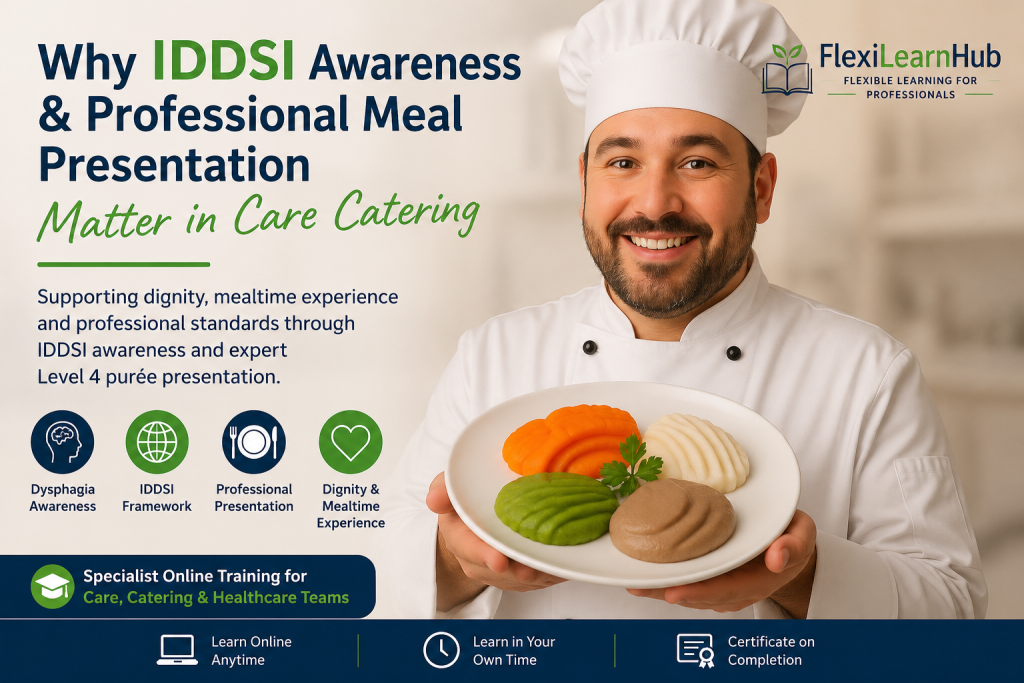
Within healthcare, care homes and specialist catering environments, awareness around dysphagia support and texture modified meals is becoming increasingly important. For many individuals requiring texture modified meals, mealtimes are not simply about nutrition. Mealtime experience, presentation, dignity and professional standards also play an important role within care environments. As awareness of dysphagia support continues to grow internationally, the IDDSI Framework has become an increasingly recognised part of care catering and healthcare foodservice environments worldwide. Understanding the IDDSI Framework The International Dysphagia Diet Standardisation Initiative, commonly known as IDDSI, provides a globally recognised framework designed to support consistency and awareness around texture modified foods and drinks. The framework helps provide standardised terminology and guidance for texture modified meals and drinks used within healthcare, aged care and specialist catering environments. Today, the IDDSI Framework is recognised across many countries worldwide and is increasingly used within care homes, healthcare catering and specialist care environments. Why Presentation Matters in Texture Modified Meals While texture modified meals are an important part of many care catering environments, presentation standards are sometimes overlooked. Meals that appear inconsistent, poorly shaped or visually unappealing may negatively affect the overall mealtime experience. Professional meal presentation can help support: Dignity during mealtimesProfessional catering standardsPositive dining experiencesWorkplace pride within catering teamsImproved visual appeal of texture modified meals Within modern care catering environments, presentation is increasingly recognised as an important part of professional foodservice standards. Supporting Dignity Through Professional Care Catering Care catering is about more than simply preparing food. For many residents and individuals within care environments, mealtimes are an important part of daily wellbeing, comfort and routine. Professional presentation and thoughtful meal preparation can help contribute to a more positive and respectful dining environment. This is one reason why awareness around dysphagia support and specialist meal presentation continues to grow within healthcare and care catering sectors. Training for Care Home Catering Teams At FlexiLearnHub, we provide specialist online training designed for real workplace environments. Our training courses help support awareness and professional understanding across both care and catering sectors. Our specialist IDDSI-related courses include: Dysphagia Care Training within The IDDSI Framework Designed to help provide awareness and understanding of dysphagia support, texture modified meals and the IDDSI Framework within care and healthcare environments. Advanced IDDSI Level 4 Professional Purée Presentation & Plating Focused on professional presentation, shaping and plating awareness for Level 4 texture modified meals within healthcare and specialist catering environments. These courses are suitable for: Care home chefsHealthcare catering teamsCatering managersKitchen assistantsCare staffSpecialist care catering environments Watch Our IDDSI Awareness Video Watch our latest YouTube video exploring the importance of IDDSI awareness and professional meal presentation within care catering environments. Explore our specialist Dysphagia & IDDSI Awareness training courses at FlexiLearnHub. Flexible Online Learning for Care & Catering Teams FlexiLearnHub provides flexible online learning designed to support modern workplaces. Learners can complete training online, in their own time, while building professional awareness and workplace understanding within care, healthcare and catering environments. Explore our online training platform today: IDDSI Dysphagia Awareness Training for Care Homes (CPD Accredited) Advanced IDDSI Level 4 Professional Purée Presentation & Plating Training View Our Courses: Group Training for Employers: